

Nasi Kandar
How Malaysia's famous curries took my love to new heights

I get most of my intel on Malaysia from chatty Grab drivers. They see me with my backpack and ask how long I’m staying in the area before I’ve managed to close the car door. When I give them my estimate, they say, ‘Okay,’ and take a deep breath, drumming their fingers on the steering wheel. This is my signal to open Maps or my Notes app, ready to pluck recommendations from their stream-of-consciousness.
When it comes to the subject of food, the first question is often, ‘do you like spice?’ ‘Yes,’ I say, ‘as long as I can still taste what I’m eating.’ They look up at me in the rear-view mirror, shocked, and laugh. I feel very smug in myself. They proceed to name off the best places for popular local dishes, like laksa, nasi lemak, roti canai, char kuey teow… The list goes on forever, because Malaysia is composed of so many strands of culture and creed.
One driver in Ipoh launches into an enthusiastic monologue about a popular Muslim Indian dish called Nasi Kandar. My ears prick up; I think I’ve read about this one online. He recommends Nasi Kandar Pelita, a well-known late-night chain in Malaysia, for my first taste of the dish. I go there that evening, glad to avoid spending 15 minutes trawling through Google reviews.
Nasi Kandar establishments are composed of white lights, stark tiles, slow ceiling fans, and furnishings made of brightly coloured plastic and industrial steel. They’re frequently open-air, with huge sprawls of tables for the inevitable rushes of families and big groups. For all the world, they’re a canteen: Behind glass lies vats of different rices, curries, vegetables and other trimmings, all of which can soon be yours to eat. At the good places, a jumbled queue formed around the counter and out onto the street will obscure what’s on offer, leaving it as a surprise for you to discover the last minute.
Restaurant staff are almost always men – with at least five of them working behind the counter at any given time - wearing matching polo shirts and hats and aprons. At first, I feel an innate reservation about going to order at one of these places – aside from not really knowing what I should order, it feels a bit like walking into other typical “boys’ clubs”, like an old man’s pub at home, or a mechanic’s. And part of me just can’t really imagine going to a completely-male restaurant and having a pleasant experience, no offence men. I wince pre-emptively, anticipating weird looks and grunts and jokes that I don’t really understand. But almost instantly I’m proven wrong.
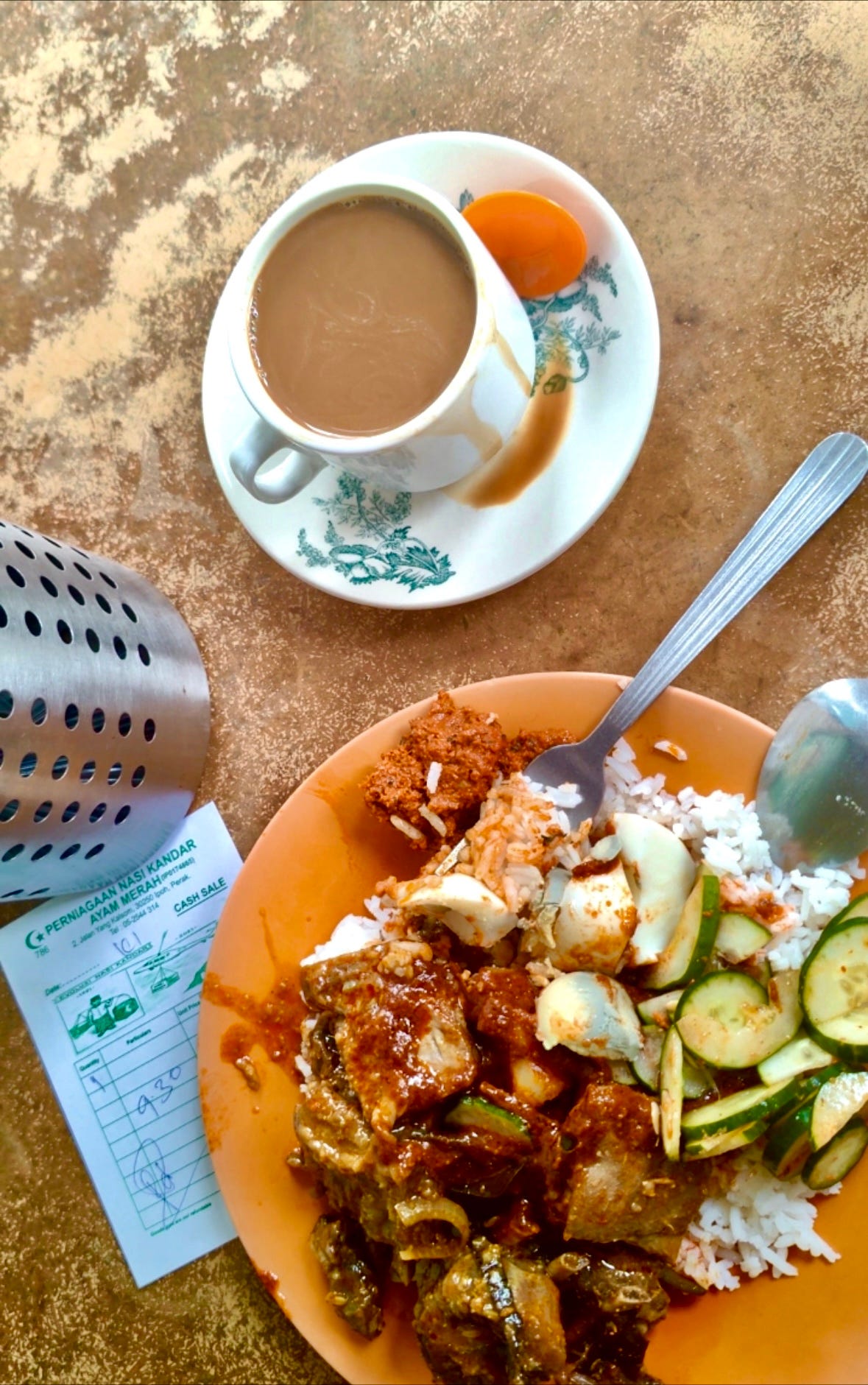
Amid the chaos and queues, they patiently guide me through what’s on offer – checking on my spice tolerance, again – and tell me what they recommend. I pick my rice and meat, and after they’re plated up, the Nasi Kandar magic happens: The man serving me adds a spoon of every curry gravy available onto my rice. Although the plate is already full – and flooded – he also offers some okra or cabbage, maybe a boiled egg. And somehow, he fits them on the mountainous plate when I accept.
I take my food, getting some errant gravy on my hands, and find a place to sit in the middle of the actvity. Someone comes to take my drink order, which is a hot teh tarik, very milky, very sweet tea that balances the curry’s flavour so well. Locals around me eat Nasi Kandar with their hands. Not quite having the stomach for that, I’m always grateful when I’m warmly given a fork and spoon. But using your hands to eat curry means that you can’t really go on your phone during the meal. Isn’t that lovely?
There’s never any music playing in these places. Instead, I listen to the restaurant with its clattering plates and shouts from the kitchen, and the diners enthusiastically chatting; babies babbling or crying; gratuitous burping; the sound of someone next to me chugging tea and viciously sucking meat and marrow from a bone.
I don’t know, this probably isn’t for everyone. Maybe some would consider this way of eating a bit gremlin-like, but that’s exactly what I enjoy about it. I go to these places alone; I don’t need to dress up, or feel self-conscious, or spend a fortune. These meals never cost more than €5, and their warmth and heartiness fuels me for hours. It puts food back into a perspective that’s both functional and pleasurable, without airs or graces or fetishization. We’re all just here to eat. I think I’d pick it over a parmesan-truffle-something-or-other any day, which seems sterile in comparison.
Restaurants like this are more common in Asia, in general. In this part of the world, eating out can be more of a necessity than a luxury. People are on-the-go, or don’t have a kitchen, or perhaps don’t have the resources for a bulky weekly food shop. In the Philippines, it was carinderias; in Taiwan, streets filled with night markets and hawker centres. The no-fuss eateries run by families and communities visibly prioritise feeding people over making silly money. I can’t tell you how grounding it is to be in environments like these, after all of the conditioning to pick politely.
Y’all know I’m a fiend for curry. I think the Nasi Kandar joints are particularly special to me, because of how much I love Indian food, and how steadfast the dishes are. In a way, it does remind me of glimmers from my past. The canteen in DCU, where on a bad day I could count on getting a decent, veggie-filled curry piled onto chips and rice for a fiver. I can see the wooden tray in my hands, as I walk around trying to find my friends, careful not to spill its piled-high contents. Govinda’s, the Hari Krishna-run cafeteria on Capel street, where we’d go for a “small” plate, two inches thick with all kinds of fragrant delights. No fuss, no weird food shame; how it should always be.